Segment
segment is the inverse of mesh: it samples an existing mesh back into a
voxelized segmentation or mesh, at a chosen element size. The element type
(hex, tet, or tri) is detected automatically from the input mesh file;
there is no separate hex/tet/tri subcommand to choose.
automesh segment --help
Creates a segmentation or voxelized mesh from an existing mesh

Usage: automesh segment [OPTIONS] --input <FILE> --output <FILE> --size <NUM>

Options:
  -i, --input <FILE>    Mesh input file (exo | inp | off | stl | vtu)
  -o, --output <FILE>   Segmentation (npy | spn | vti) or mesh (exo | inp | mesh | vtu) output file
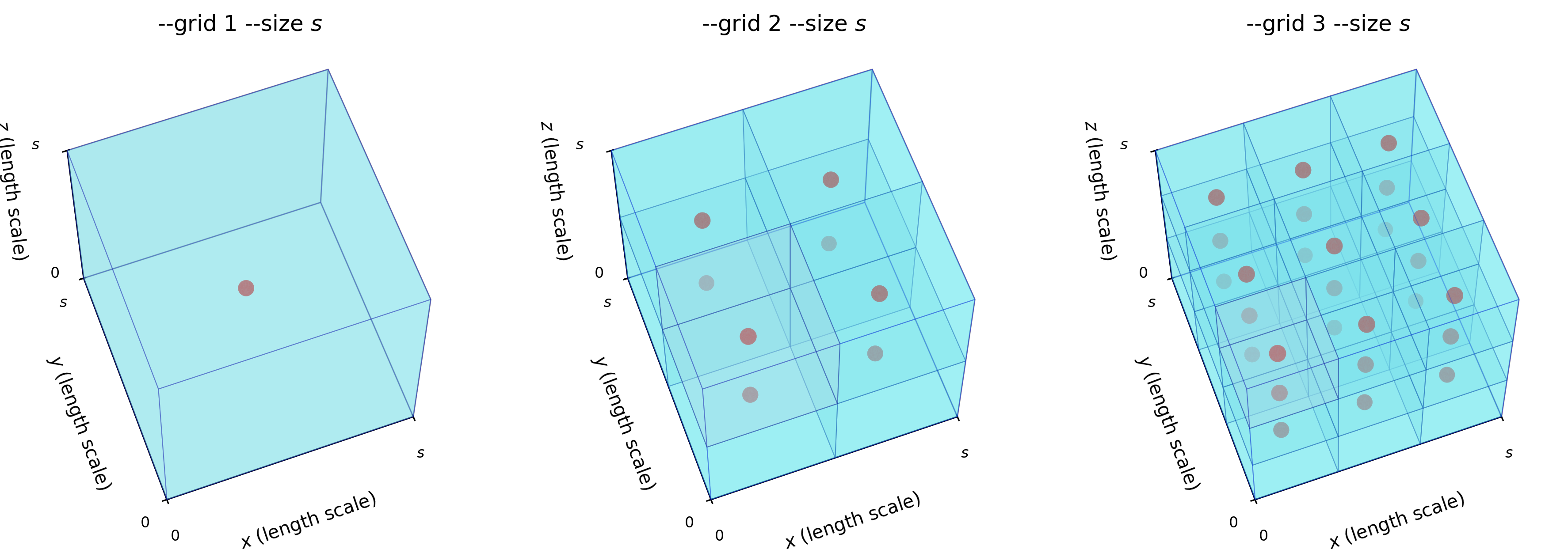
  -g, --grid <NUM>      Grid length for sampling within each element (currently unused) [default: 1]
  -s, --size <NUM>      Element size which is the side length
  -r, --remove <ID>...  Block IDs to remove from the segmentation
  -h, --help            Print help

Global options:
      --log <FILE>  Mirror terminal output to a log file
  -q, --quiet       Pass to quiet the terminal output
Sample Points
The input mesh is queried for its material composition for
--grid 1: at a single discrete sample point located at the center of a voxel,--grid 2: at eight discrete sample points located in a2x2x2arrangement within subdivided cells of the voxel,--grid 3: at 27 discrete sample points located within a3x3x3arrangement within subdivided cells of the voxel,- and so on.
The --grid and --size options are illustrated below for three successive grid sizes: