Equilibration
Stage 2 of five. Operates on cells. See Hexahedral Meshing from a Surface for the pipeline overview and terminology.
Two conditions must hold before the octree can be dualized: the tree must be balanced, and its transition regions must be paired.
Balancing
Balancing limits the depth difference between neighboring cells. automesh offers two rules, and the choice between them is the single most consequential quality decision available to the user.
- Weak balancing — the default — constrains only cells sharing a face.
- Strong balancing —
--strong— additionally constrains cells sharing an edge or a vertex.
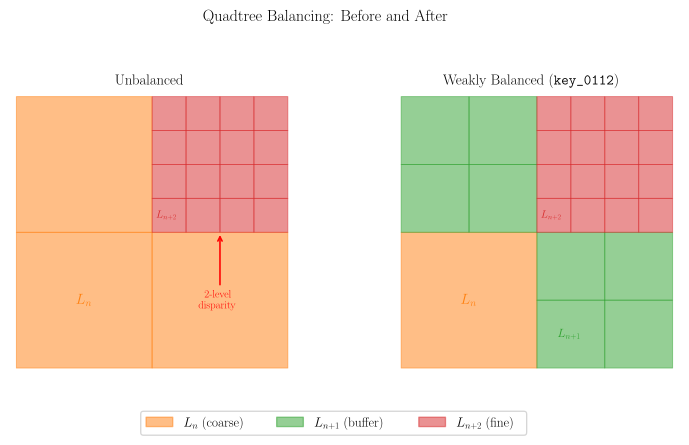
The figure shows the 2D quadtree analogue. Balancing inserts intermediate cells — the buffer level — wherever a coarse cell at would otherwise abut a fine cell at directly, so that no two neighbors differ by more than one level.
Strong balancing is the more restrictive condition, so it refines more cells and yields a larger mesh. In exchange, it admits a strictly smaller set of dual templates, and therefore guarantees better interior quality:
| Weak (default) | Strong (--strong) | |
|---|---|---|
| Neighbors constrained | face | face, edge, vertex |
| Distinct template configurations | 12 | 10 |
| Guaranteed interior minimum scaled Jacobian | ||
| Relative mesh size | smaller | larger |
For the Stanford bunny at --scale 10, strong balancing produced about 11% more elements at the dualization stage than weak — a modest cost for eliminating the two lowest-quality template configurations entirely. When interior element quality matters, prefer --strong. The catalogs behind this table are given in Template Quality.
Note that the two bounds coincide on simple convex geometry: a sphere attains under either rule. The distinction only emerges on topologically complex models — which are precisely the models where quality is hardest to recover afterward.
Pairing
Pairing ensures that transition regions are configured such that a dual template exists for every cell. automesh uses the regular pairing rule.
The two conditions interact: enforcing one can violate the other. Equilibration therefore alternates between balancing and pairing, repeating until a pass makes no further change — a fixed point — rather than applying each once in sequence.
Previous: Octree Construction. Next: Dualization, which converts the equilibrated octree into hexahedra.