Subdivision
Surface subdivision is a geometric modeling technique that defines smooth curves or surfaces as the limit of a sequence of successive refinements.
Developed as a generalization of spline surfaces, subdivision allows for the representation of complex, arbitrary control meshes while avoiding the topological constraints and "cracking" issues often associated with traditional Non-Uniform Rational B-Splines (NURBS).
Various algorithms have been established to handle different mesh types and desired continuity:
- The Catmull-Clark scheme is frequently used for quadrilateral meshes to produce continuous surfaces, while
- The Loop subdivision scheme is a popular approximating method specifically designed for triangular meshes.
By iteratively applying simple refinement rules—typically involving a "splitting" step to increase resolution and an "averaging" step to relocate vertices—subdivision transforms a coarse initial shape into a highly detailed, smooth limit surface suitable for high-end animation and scalable rendering.
Octa Loop
This example uses Loop subdivision to transform an octahedron into a sphere. The results below are based on Octa-Loop Subdivision Scheme (GitHub).
We create a unit radius octahedron template, and successively refine it into a sphere. The sphere is a useful baseline subject of study because it:
- Can easily be approximated by a voxel stack at various resolutions,
- Can easily be approximated by a finite element mesh,
- Has a known analytic volume, and
- Has a known analytic local curvature.
Base Octahedron
We created a unit radius template, octa_base.obj, with contents listed below:
v 1.0 0.0 0.0
v 0.0 1.0 0.0
v -1.0 0.0 0.0
v 0.0 -1.0 0.0
v 0.0 0.0 1.0
v 0.0 0.0 -1.0
f 1 2 5
f 2 3 5
f 3 4 5
f 4 1 5
f 2 1 6
f 3 2 6
f 4 3 6
f 1 4 6
Refinement
The refinement below was created with MeshLab 2022.02, Subdivision Surfaces LS3 Loop, based on Boye et al.1
| name | image | file size |
|---|---|---|
octa_loop00.stl | 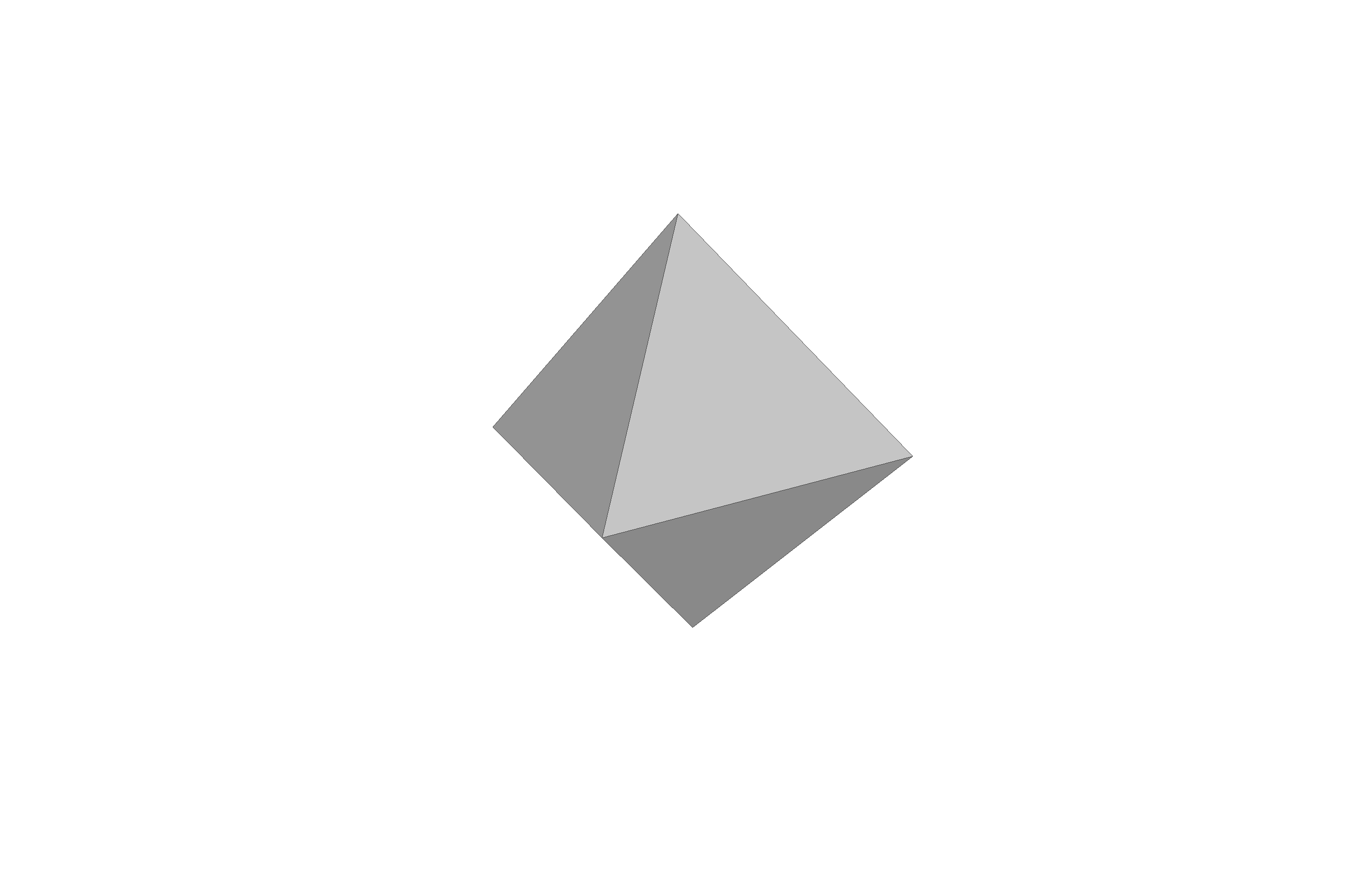 | 2.1kB |
octa_loop01.stl | 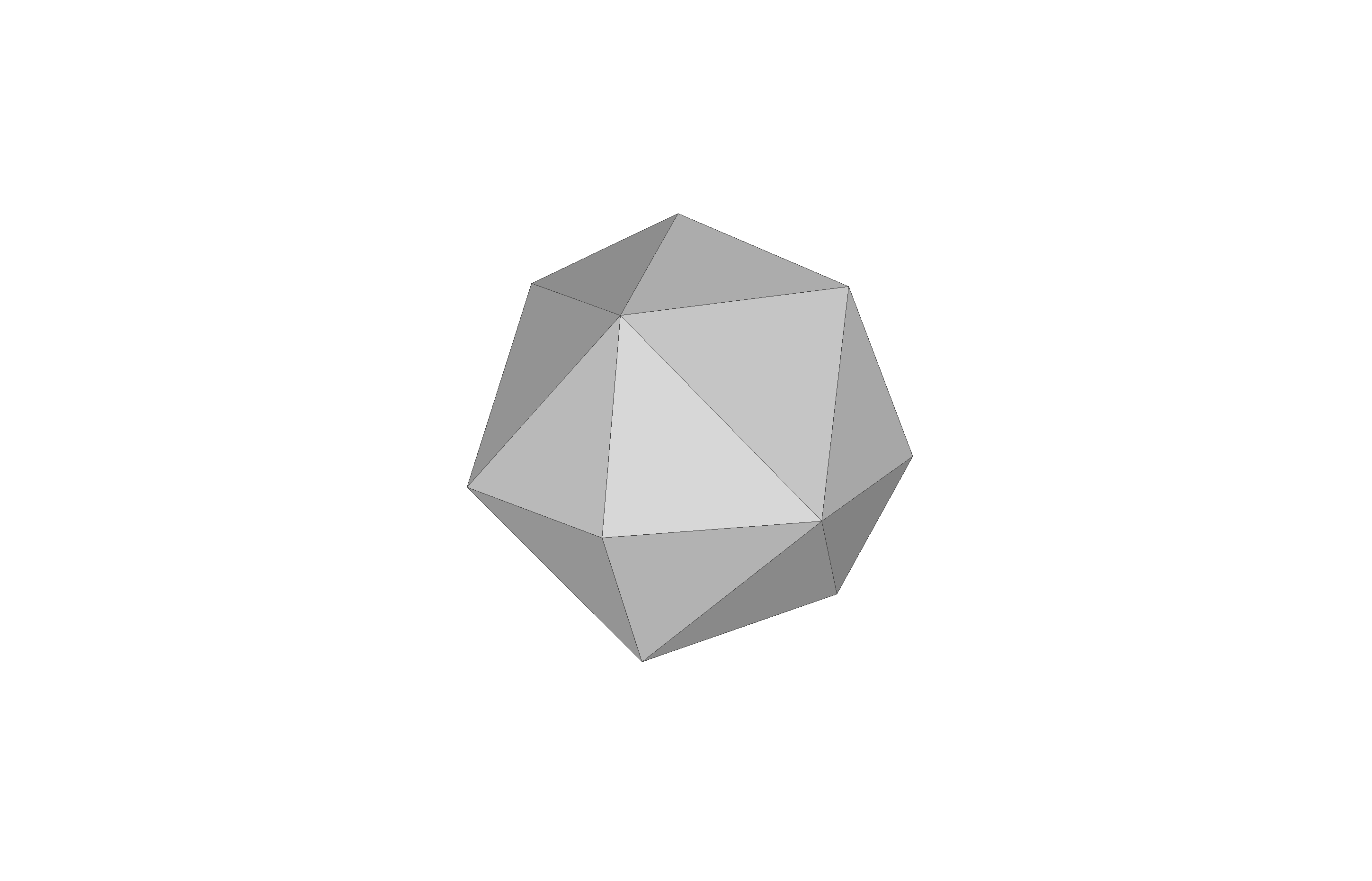 | 8.3kB |
octa_loop02.stl G | 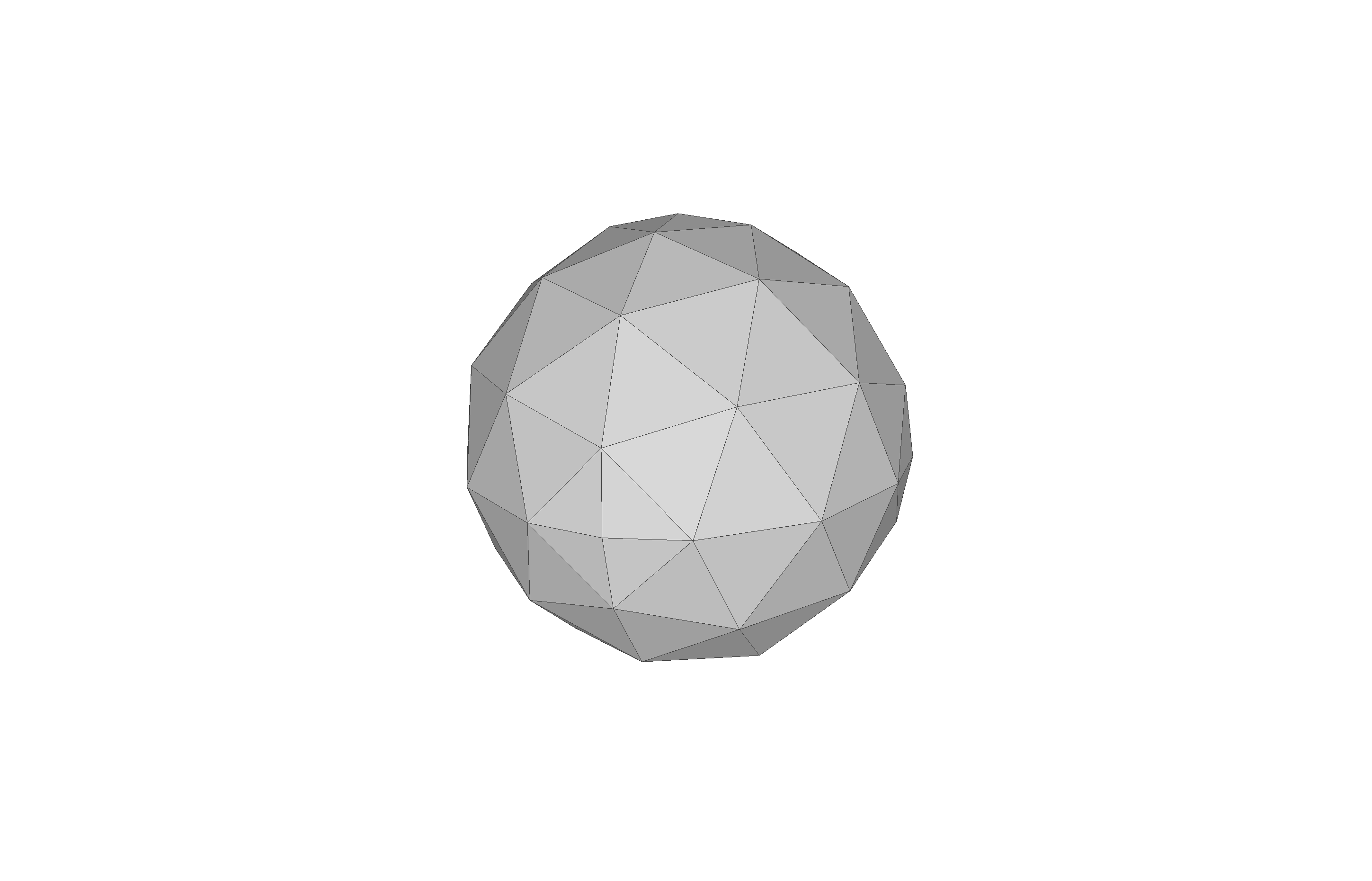 | 33kB |
octa_loop03.stl G | 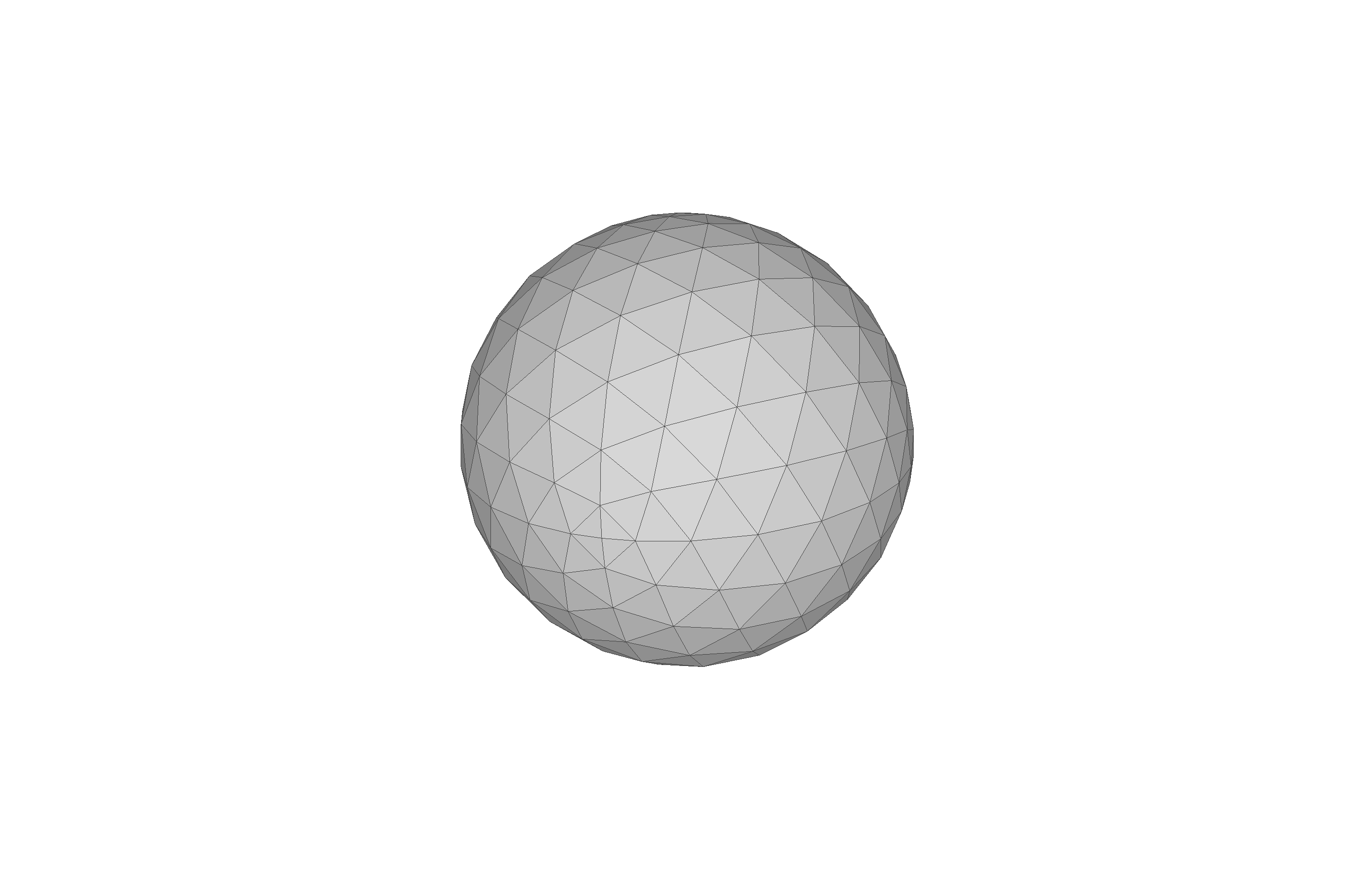 | 132kB |
octa_loop04.stl G | 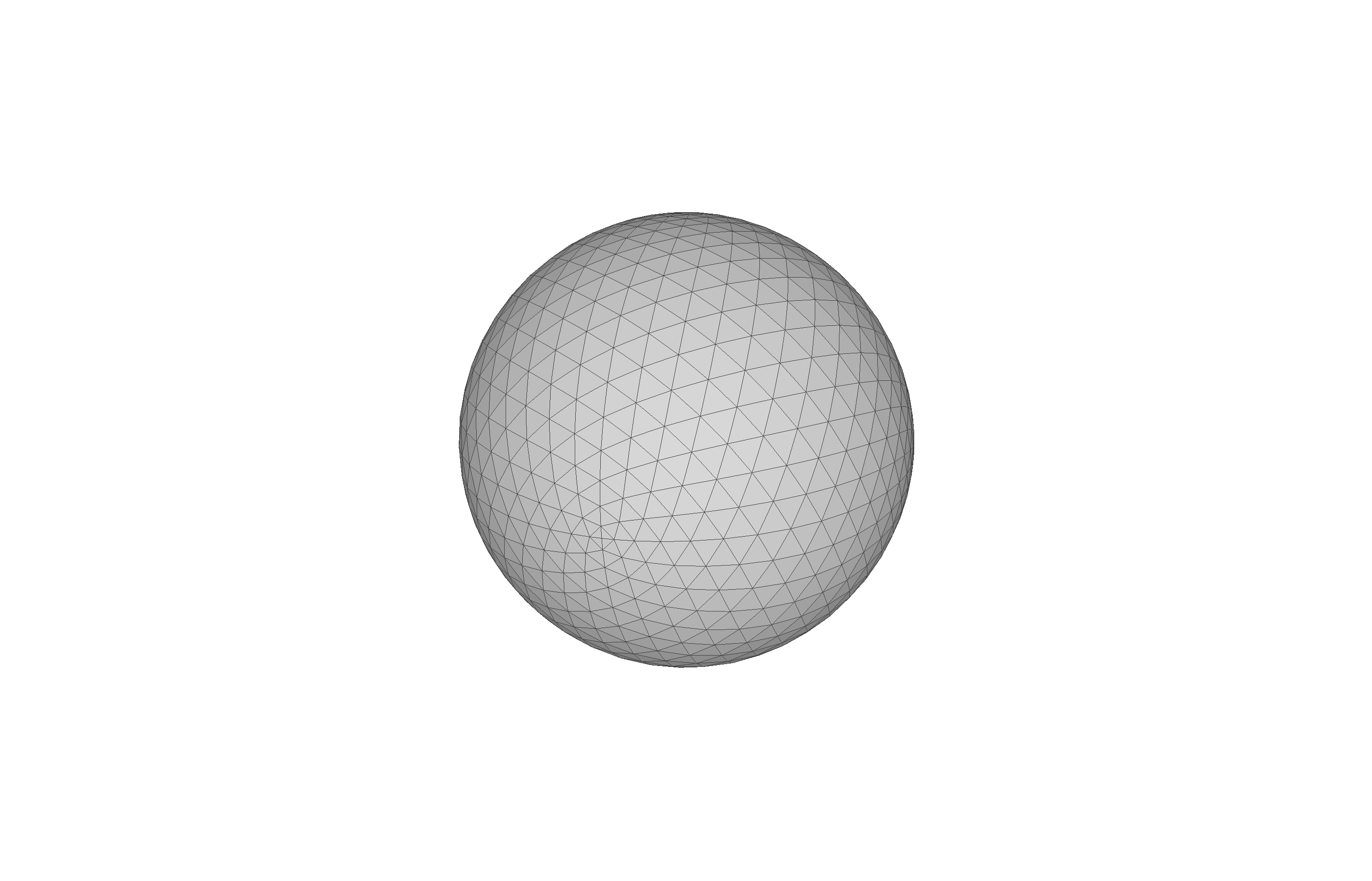 | 526kB |
octa_loop05.stl G | 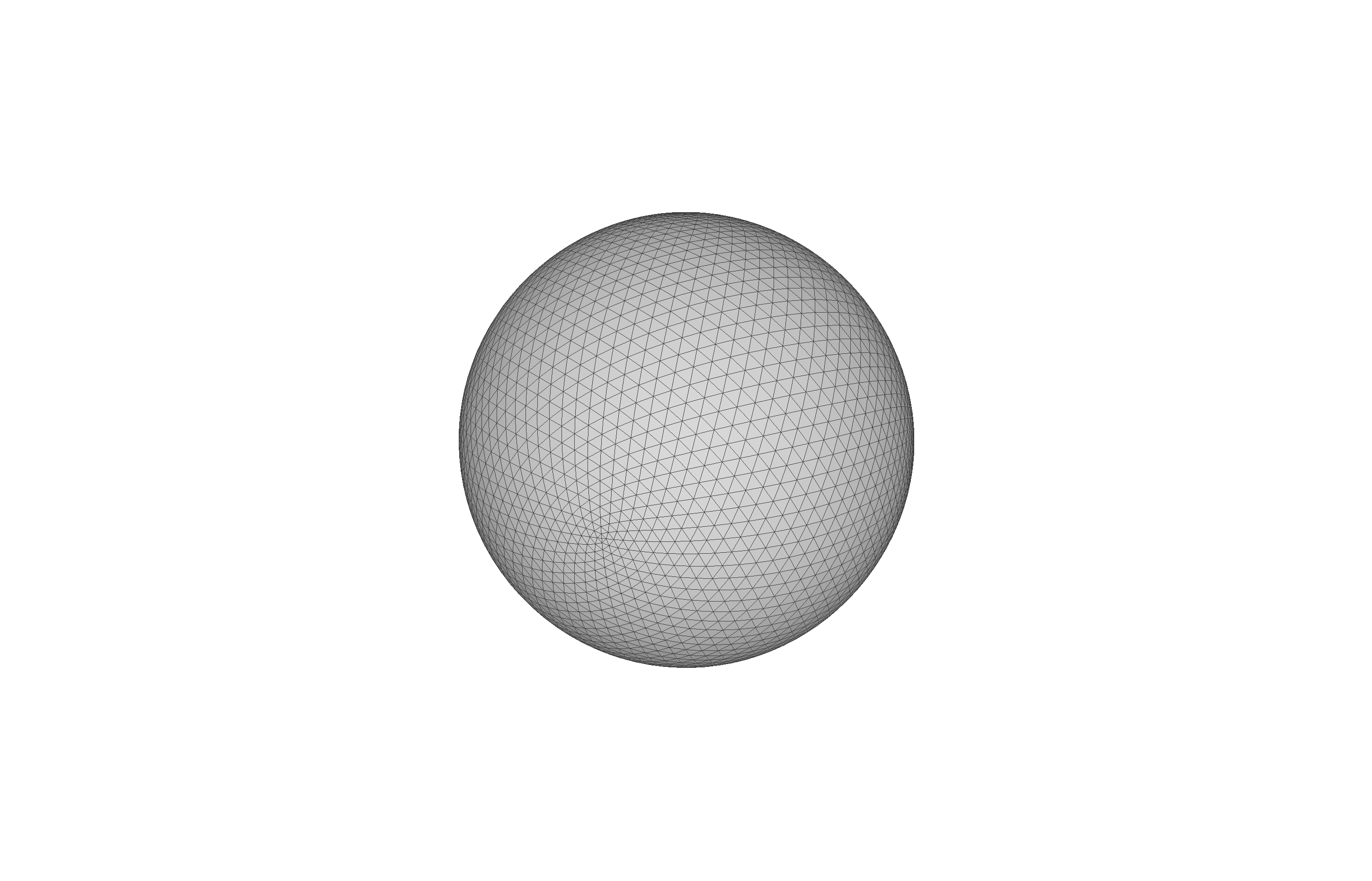 | 2.1MB |
octa_loop06.stl G | 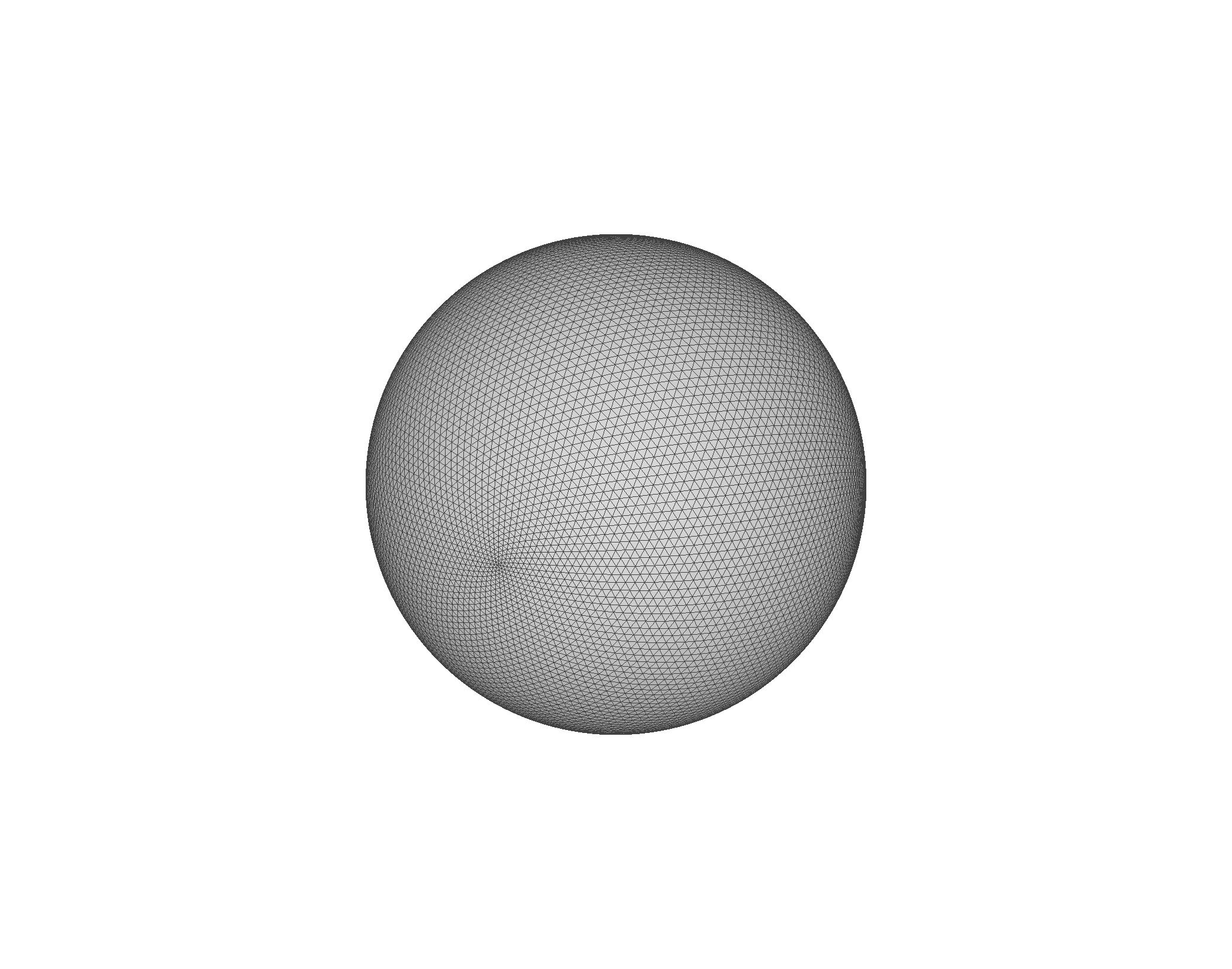 | 8.6MB |
octa_loop07.stl G |  | 33MB |
Items with
Gare not on the repository; they are on Google Drive because of their large file size.
Geometric Metrics
- The surface area of a sphere is , and when , .
- The volume of a sphere is , and when , .
Using the Euler Characteristic for a sphere (), we can verify the progression from the base octahedron ():
| Iteration () | Vertices () | Edges () | Faces () | Calculation () |
|---|---|---|---|---|
| 0 (Base) | 6 | 12 | 8 | 6+12=18 |
| 1 | 18 | 48 | 32 | 18+48=66 |
| 2 | 66 | 192 | 128 | 66+192=258 |
| 3 | 258 | 768 | 512 | 258+768=1,026 |
| 4 | 1,026 | 3,072 | 2,048 | 1,026+3,072=4,098 |
| 5 | 4,098 | 12,288 | 8,192 | 4,098+12,288=16,386 |
| 6 | 16,386 | 49,152 | 32,768 | 16,386+49,152=65,538 |
| 7 | 65,538 | 196,608 | 131,072 | 65,538+196,608=262,146 |
The recursive relationships for a closed triangular mesh:
- Faces:
- Edges:
- Vertices:
Sculpt Baseline
We created Sculpt baseline meshes with the sculpt_stl_to_inp.py script as
(atmeshenv) ~/autotwin/mesh/src/atmesh> python sculpt_stl_to_inp.py
and create standard views in Cubit with
Cubit>
graphics perspective off  # orthogonal, not perspective view
up 0 0 1  # z-axis points up
view iso # isometric x, y, z camera
quality volume 1 scaled jacobian global draw histogram draw mesh list
to produce the following results:
| iter | image | cells | nodes nnp | elements nel | element density nel |
|---|---|---|---|---|---|
| 0 | 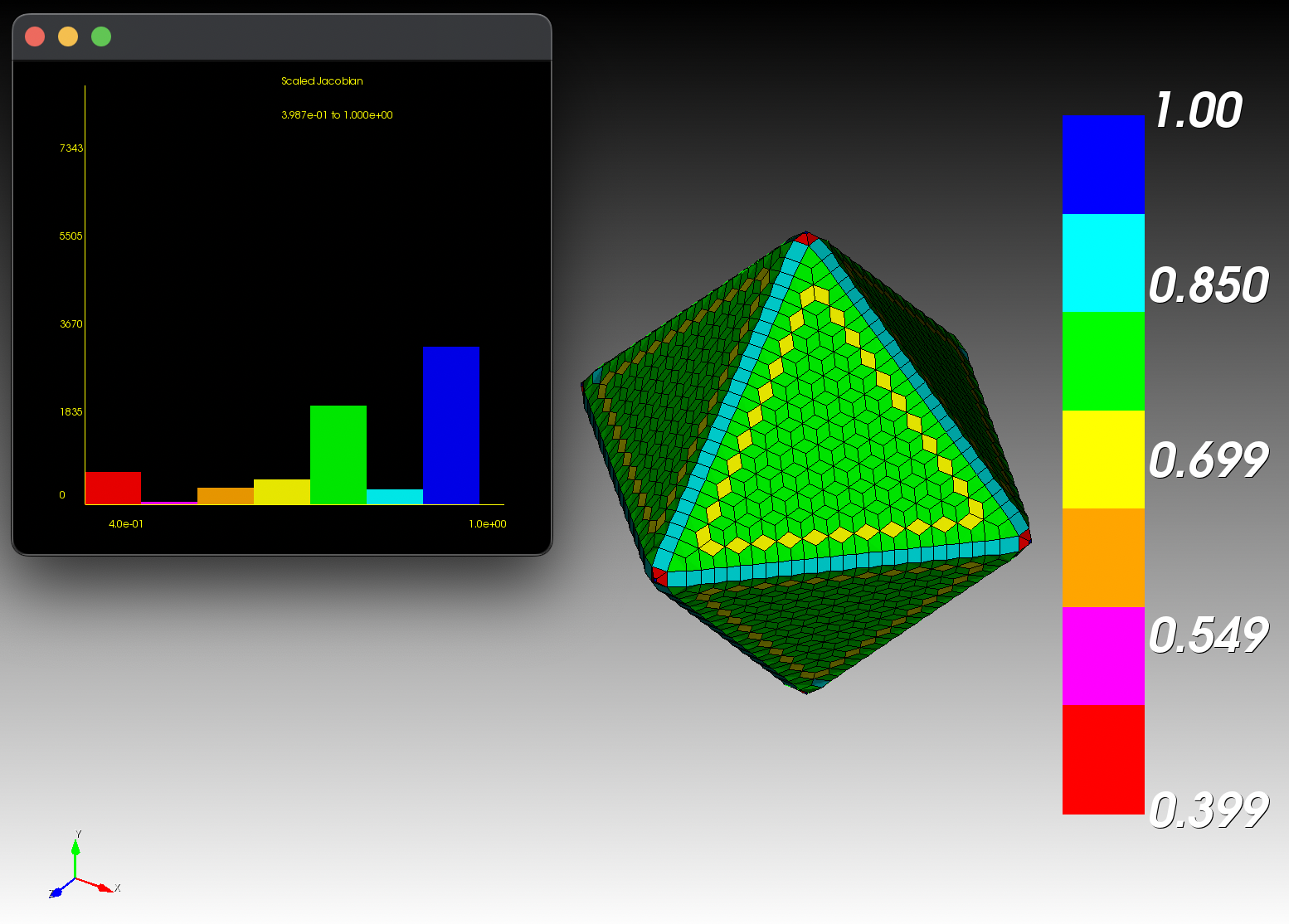 | 35x35x35 | 8,696 | 7,343 | 5,507 |
| 1 | 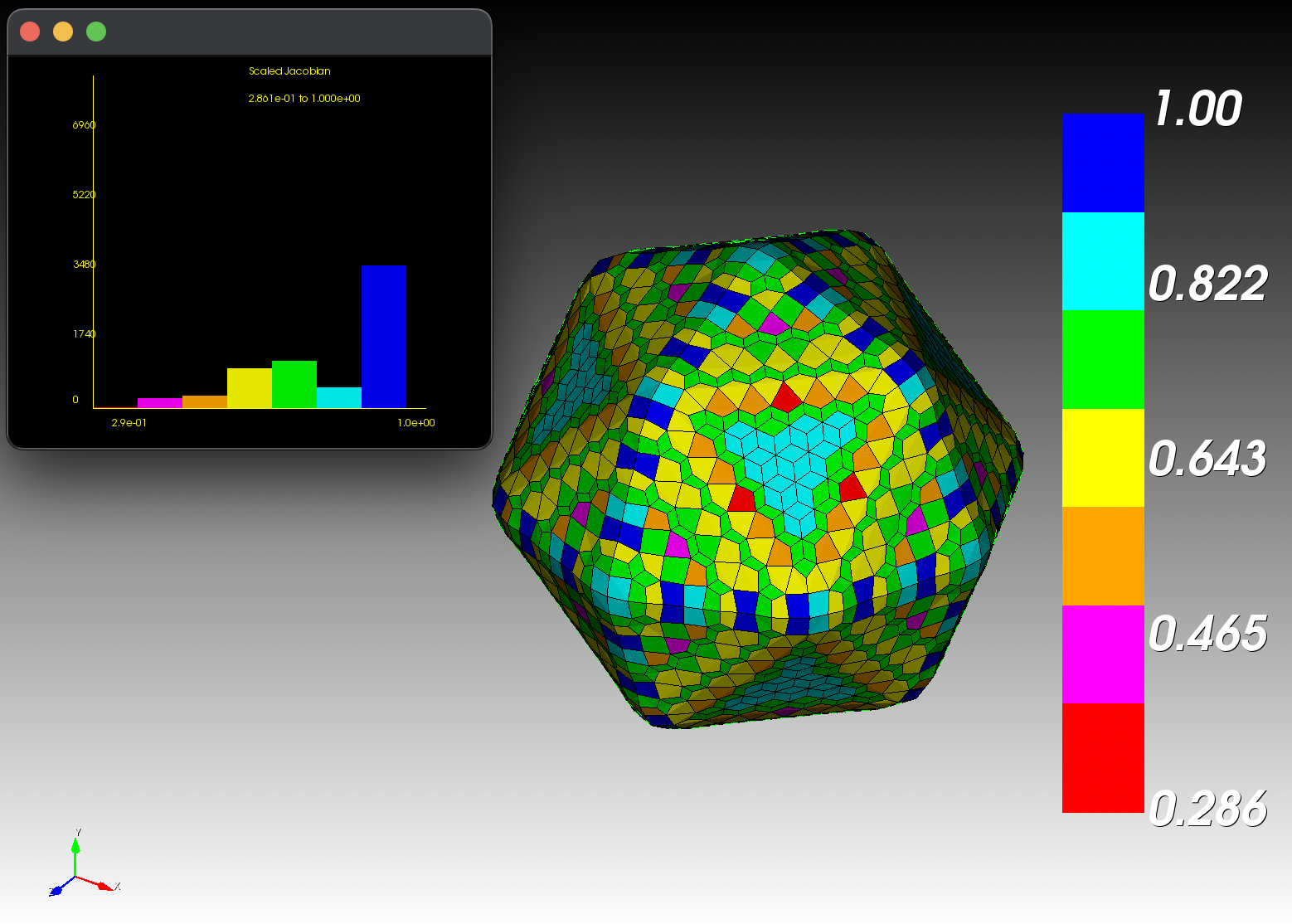 | 28x28x28 | 8,133 | 6,960 | 2,365 |
| 2 | 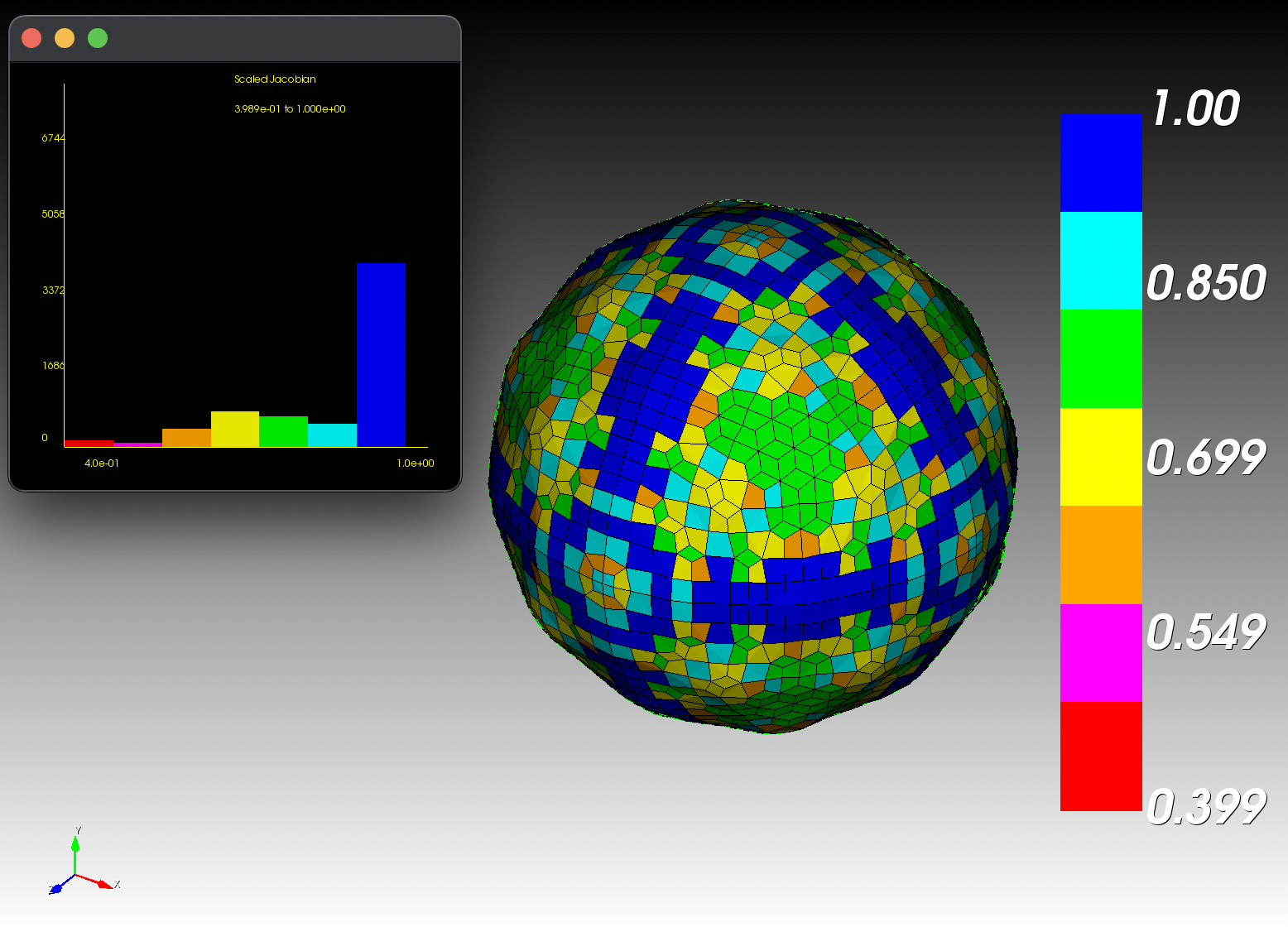 | 26x26x26 | 7,833 | 6,744 | 1,762 |
| 3 | 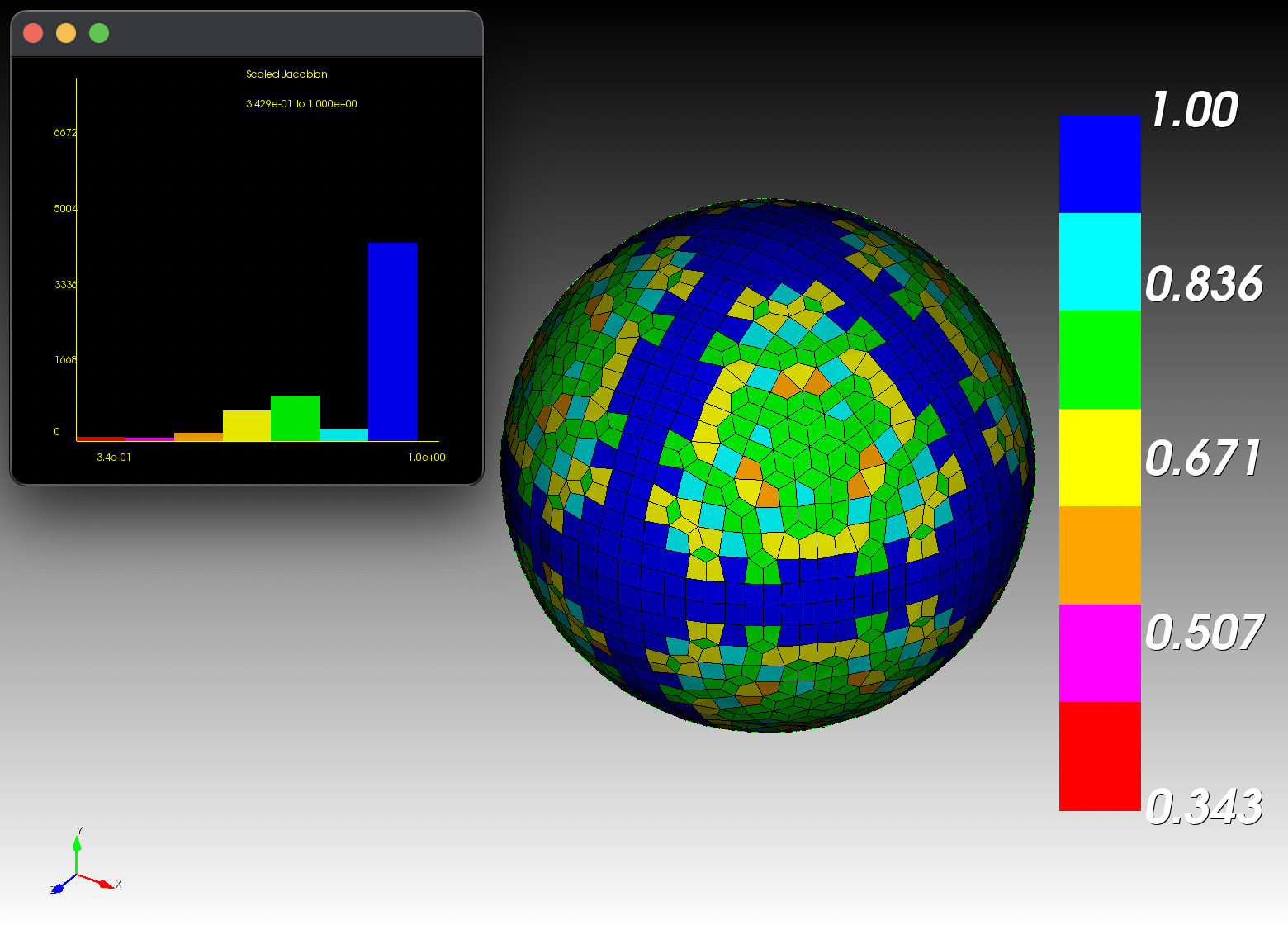 | 26x26x26 | 7,731 | 6,672 | 1,630 |
| 4 | 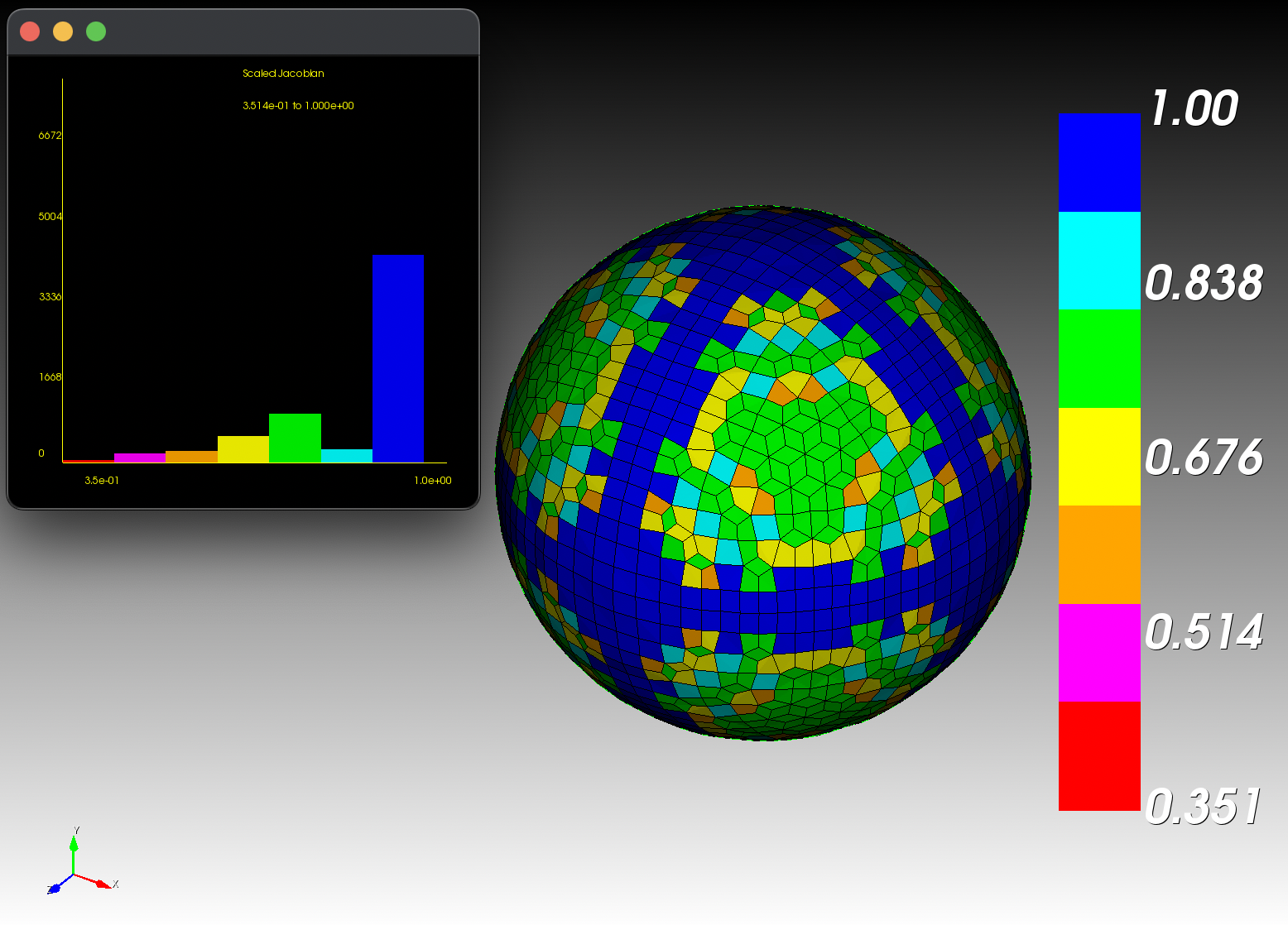 | 26x26x26 | 7,731 | 6,672 | 1,600 |
| 5 | 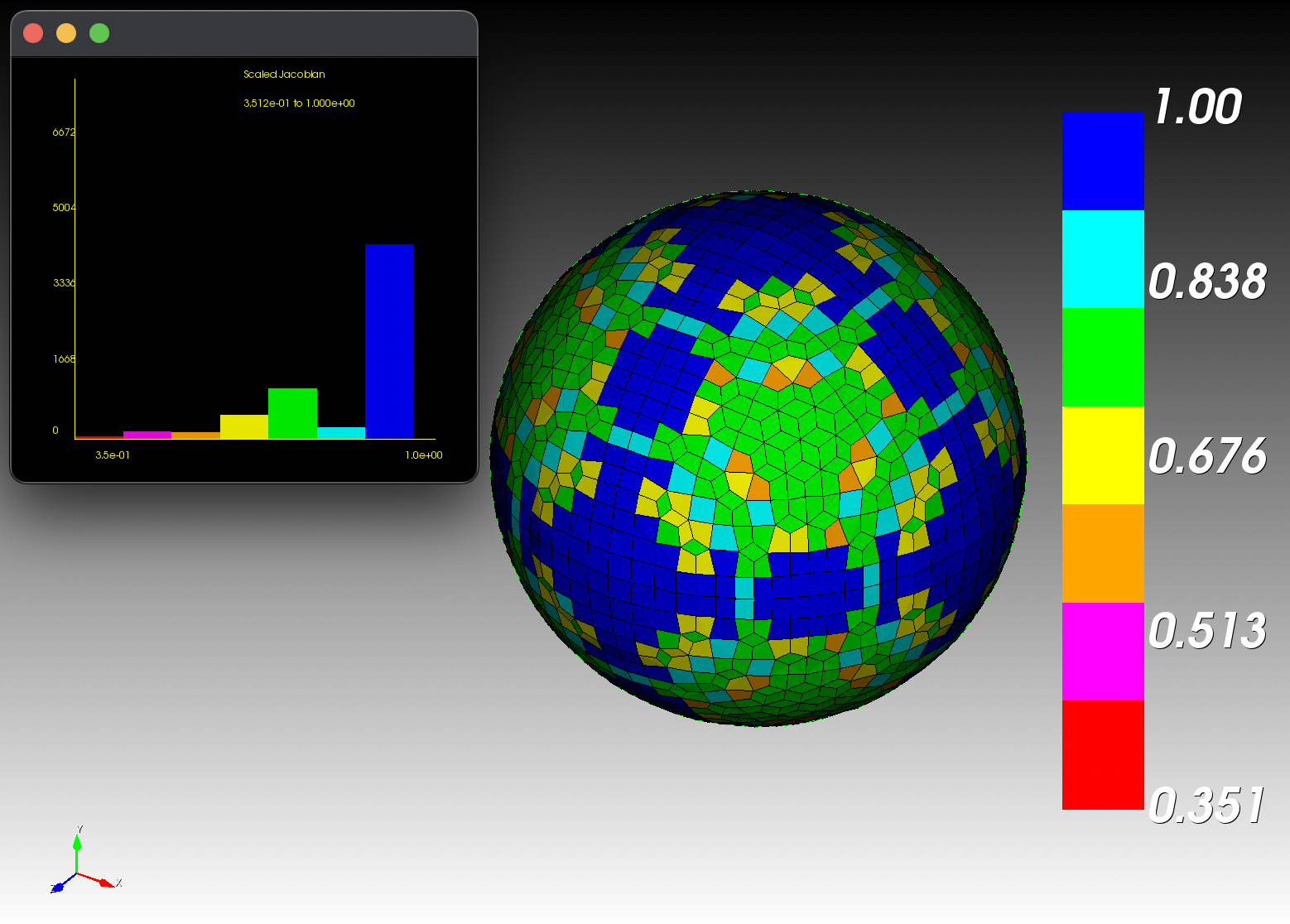 | 26x26x26 | 7,731 | 6,672 | 1,596 |
| 6 | 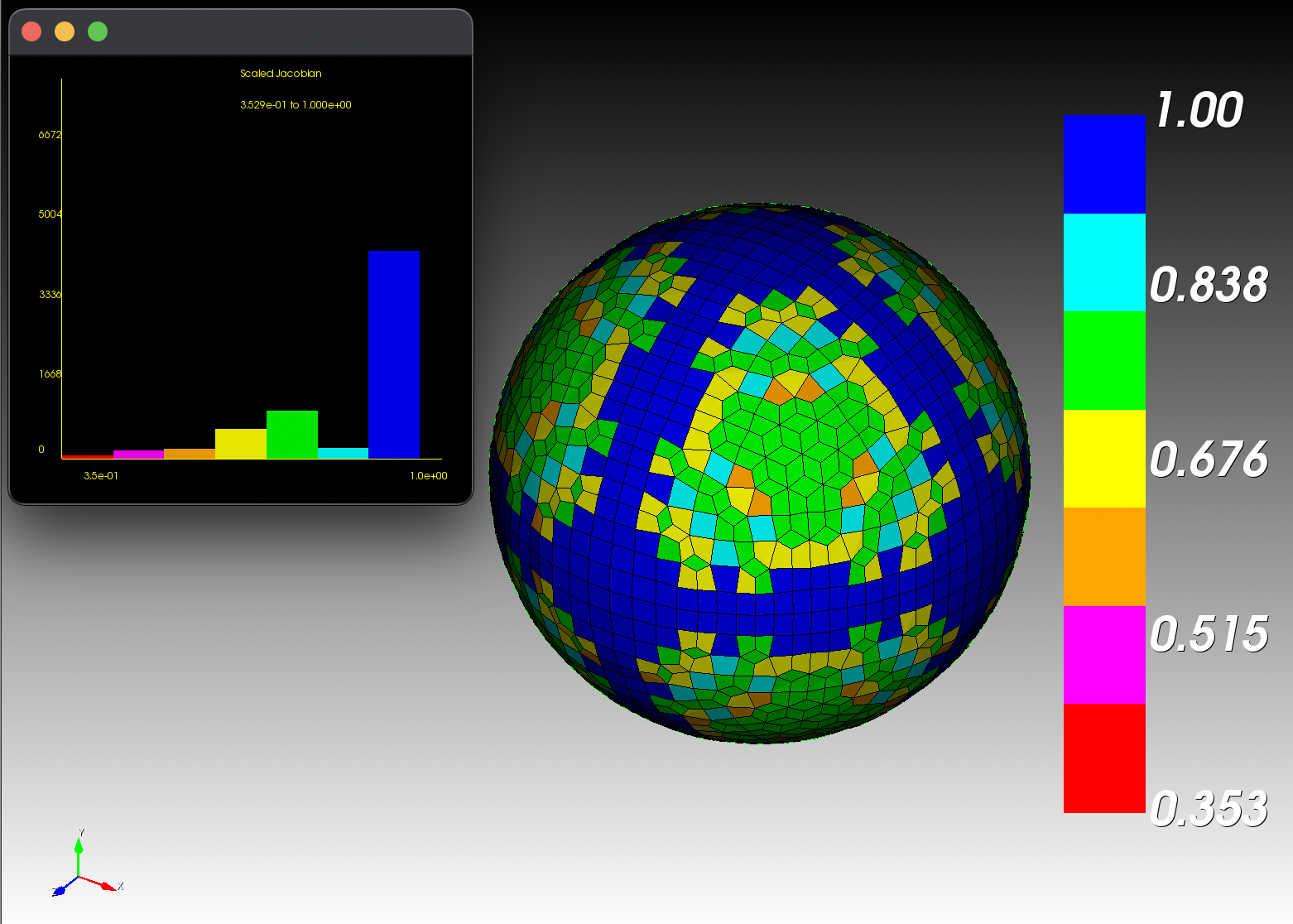 | 26x26x26 | 7,731 | 6,672 | 1,595 |
| 7 | 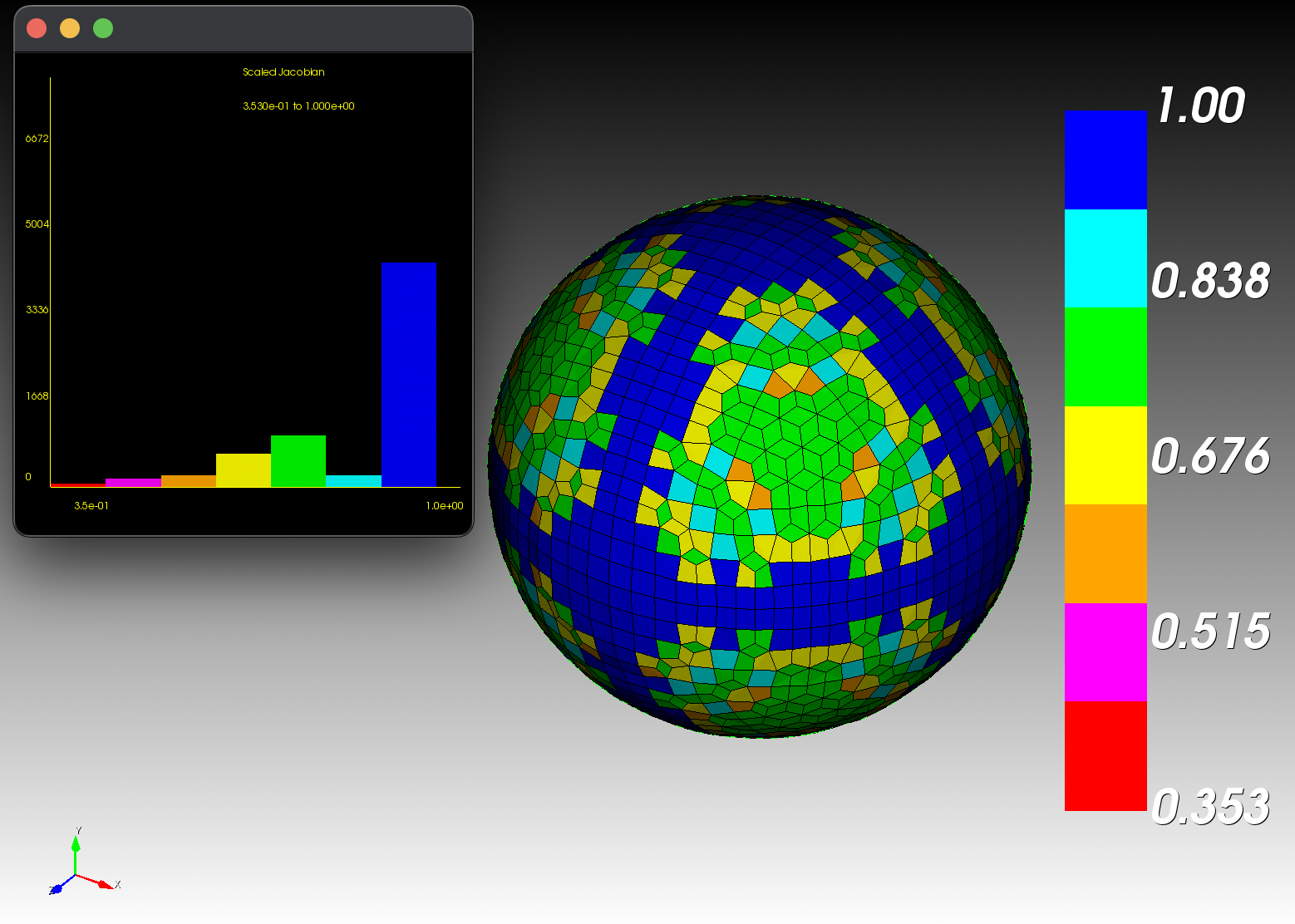 | 26x26x26 | 7,731 | 6,672 | 1,595 |
References
- Octa-Loop Subdivision Scheme (GitHub)
- Documentation detailing the Octa-Loop scheme, a variant of Loop subdivision optimized for octahedrally refined meshes.
- Subdivision Surfaces Lecture Notes (Stanford University)
- A comprehensive academic overview of subdivision concepts, including the mathematical foundations of the Catmull-Clark and Loop schemes.
- Stanford cs468-10-fall Subdivision http://graphics.stanford.edu/courses/cs468-10-fall/LectureSlides/10_Subdivision.pdf and Google Drive repo copy
- Catmull–Clark Subdivision Surface (Rosetta Code)
- A technical resource providing algorithmic steps and multi-language code implementations for the Catmull-Clark subdivision process.
- Recursively Generated B-Spline Surfaces (Original Paper)
- The seminal 1978 paper by Edwin Catmull and James Clark that introduced the method for generating smooth surfaces from arbitrary topological meshes (referenced within the other materials).
- Catmull, E., & Clark, J. (1978). Recursively generated B-spline surfaces on arbitrary topological meshes. Computer-Aided Design, 10(6), 350-355. https://doi.org/10.1016/0010-4485(78)90110-0
- Loop, C. (1987). Smooth subdivision surfaces based on triangles [Master's thesis, University of Utah]. https://www.microsoft.com/en-us/research/wp-content/uploads/2016/02/thesis-1.pdf
- https://docs.juliahub.com/Meshes/FuRcu/0.17.1/algorithms/refinement.html#Catmull-Clark
-
Boyé S, Guennebaud G, Schlick C. Least squares subdivision surfaces. In Computer Graphics Forum 2010 Sep (Vol. 29, No. 7, pp. 2021-2028). Oxford, UK: Blackwell Publishing Ltd. ↩