Marching Cubes
Marching Cubes, originally proposed by Lorensen and Cline in 19871,
operates on each voxel in the 3D grid on an independent basis.
For each voxel, the eight nodes of the voxel are evaluated as outside (0) the scalar field or inside (1) the scalar field. The eight nodes, classified as either 0 or 1, create 256 () possible configurations. Of these combinations, only 15 are unique configurations, after symmetry and rotation considerations. For each configuration, Marching Cubes generates a set of triangles to approximate the isosurface.
Ambiguous Cases
Some configurations of the original table have more than one valid triangulation. An example is a cube face with two diagonal nodes inside and two outside. The original table picks one triangulation per configuration. Two cubes that share such a face can then pick incompatible triangulations. The result is a crack, or an edge shared by more than two triangles.
Manifold: "The mesh forms a 2D manifold if the local topology is everywhere equivalent to a disc; that is, if the neighborhood of every feature consists of a connected ring of polygons forming a single surface (see Figure 2 of Luebke2 reproduced below). In a triangulated mesh displaying manifold topology, exactly two triangles share every edge, and every triangle shares an edge with exactly three neighboring triangles. A 2D manifold with boundary permits boundary edges, which belong to only one triangle."
| manifold | non-manifold |
|---|---|
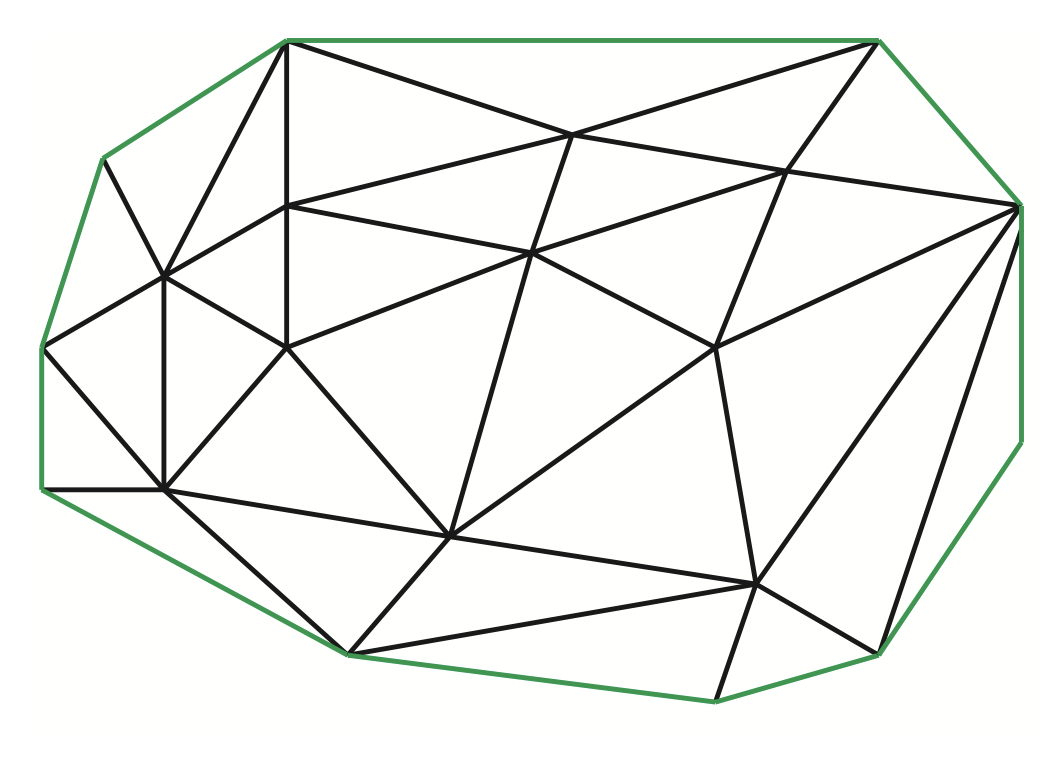 | 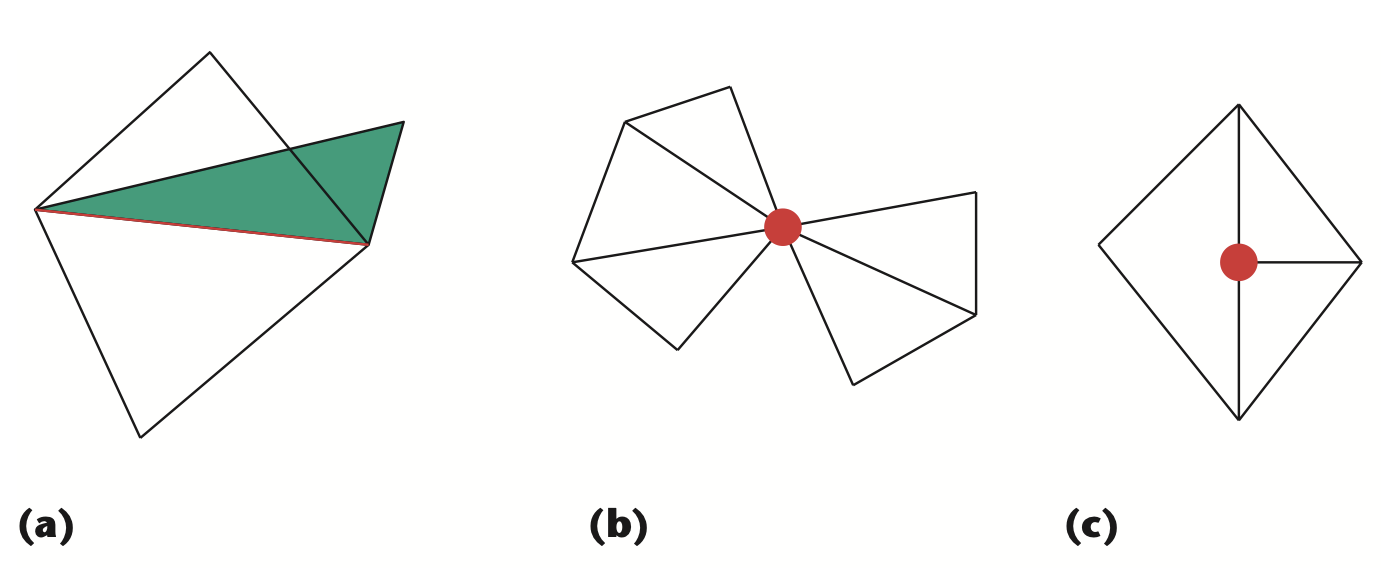 |
Figure 7.2-1: Reproduction of Luebke2 Figure 2 (left) showing a manifold mesh, and Figure 3 (right) showing a non-manifold mesh because of (a) an edge shared by more than two triangles, (b) a vertex shared by two unconnected sets of triangles, and (c) a T-junction vertex.
Lewiner et al.3 resolve the ambiguous cases.
Their algorithm adds the missing cases to the original table.
It picks each triangulation so that two cubes sharing a face agree on that face.
This removes the cracks that the original table can produce.
automesh uses this variant.
A binary field needs one further caution.
It takes only the values 0 and 1, so the level 0.5 equals the field value at the saddle of an ambiguous face.
At such a tie, the Lewiner method can leave an edge shared by more than two triangles.
The tie arises only where the segmentation contains an ambiguous configuration.
The unit sphere does not create this pathology.
Marching Cubes in automesh
mesh tri --cubes marching extracts the surface of each material separately.
automesh builds the scalar field from the segmentation, one material at a time:
- The field is
1.0at every voxel of the material and0.0elsewhere. - A one-voxel border of
0.0surrounds the field, so the surface closes at the edge of the grid. - The surface sits where the field equals
0.5, halfway between0and1. - Every grid edge that the surface crosses runs from a
0to a1, so the surface crosses it at its midpoint. Every output vertex therefore sits at the midpoint of a grid edge. - Degenerate triangles are not output.
mesh hex --marching and --inflate use the same extraction on a uniform lattice cut by a tessellation.
Advantages
- Simple implementation; uses only interpolation between voxel corners.
- Interpolates along edges between voxel corners. With a continuous scalar field, this gives a smooth surface. This can be an advantage when smooth meshes are desired but is a disadvantage when sharp edges are desired.
- With the Lewiner variant, the ambiguous cases do not produce cracks or inconsistent triangulations.
Disadvantages
- The surface is only as smooth as the scalar field.
automeshsupplies a binary field, so the interpolation puts every vertex at an edge midpoint. The surface is a chamfered version of the voxel staircase, not a smooth surface.mesh tri smoothremoves more of it. - It cannot place a vertex inside a voxel, so it does not preserve sharp features. Dual Contouring does.
Multi-material interfaces
automesh runs Marching Cubes once per material, and each run extracts that material's boundary independently.
Each material gets its own block of triangles.
Two adjacent materials each carry a copy of their shared interface.
The two copies coincide in position, and they are separate nodes, so the mesh is not merged across the interface.
Wu and Sullivan4 classify each cube by the set of labels that touch it. Frisken5 extends the Dual Contouring family the same way. Either would be the reference for a multi-label method.
References
-
Lorensen WF. Marching cubes: A high resolution 3D surface construction algorithm. Computer Graphics. 1987;21. link ↩
-
Luebke DP. A developer's survey of polygonal simplification algorithms. IEEE Computer Graphics and Applications. 2001 May;21(3):24-35. link ↩ ↩2
-
Lewiner T, Lopes H, Vieira AW, Tavares G. Efficient implementation of Marching Cubes' cases with topological guarantees. Journal of Graphics Tools. 2003;8(2):1-15. link ↩
-
Wu Z, Sullivan JM Jr. Multiple material marching cubes algorithm. International Journal for Numerical Methods in Engineering. 2003;58(2):189-207. link ↩
-
Frisken SF. SurfaceNets for multi-label segmentations with preservation of sharp boundaries. Journal of Computer Graphics Techniques. 2022;11(1):34-54. link ↩